Pterosaur Eyewitness

For eyewitnesses of apparent living pterosaurs

Browsing Posts in United States sighting

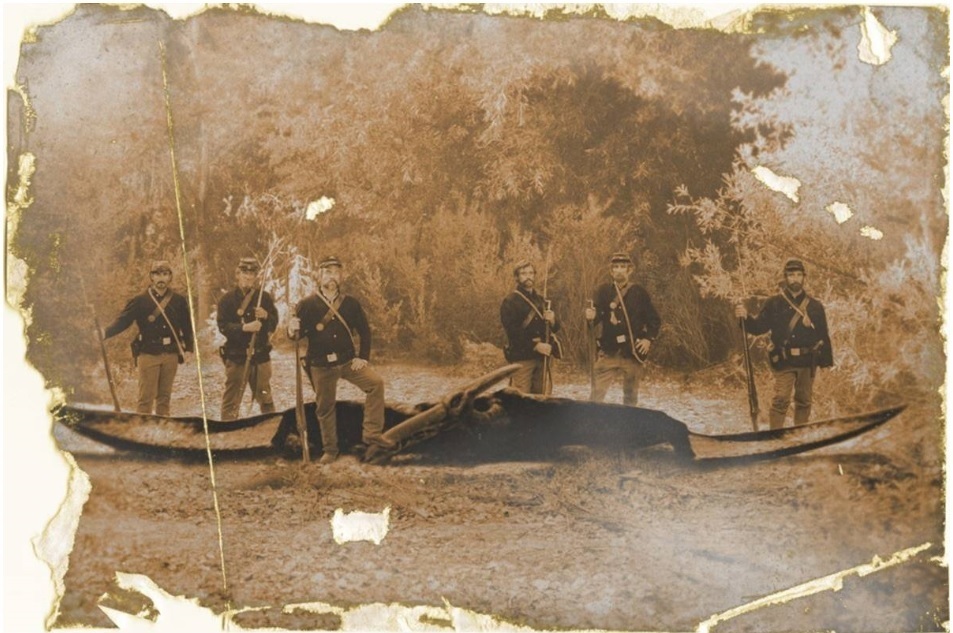
Have you ever seen a photograph of what looks like a modern pterosaur? We now examine one of the better-known photos, what appears to be a Pteranodon with Civil War soldiers:

It looks like six Civil War soldiers gathered around an apparent Pteranodon

Is this a genuine photograph from the Civil War? (click on it for enlargement)

After hours of online searching, I have found extremely differing interpretations. On Dale Drinnon’s Frontiers of Zoology blog (in a post dated 16-May-2012), he dismisses this image as “a recent construction using photoshop, not a very old photo at all . . .” but he seems to miss a critical point that shoots down all the value of Photoshop evidence.

Drinnon points out places where blur is used and where image insertion seems evident. But why would those particular photo effects be used? He fails to dig deeply, apparently assuming there is no need. Why take this photo seriously if Photoshop effects are obvious? I find several reasons to take this seriously enough to continue investigating this photo. Consider these questions, remembering that Photoshop was first used by the public in 1990:

  1. Was this apparent photo constructed recently, using Photoshop?
  2. Why do some persons say that they remember this photo in a publication before 1970?
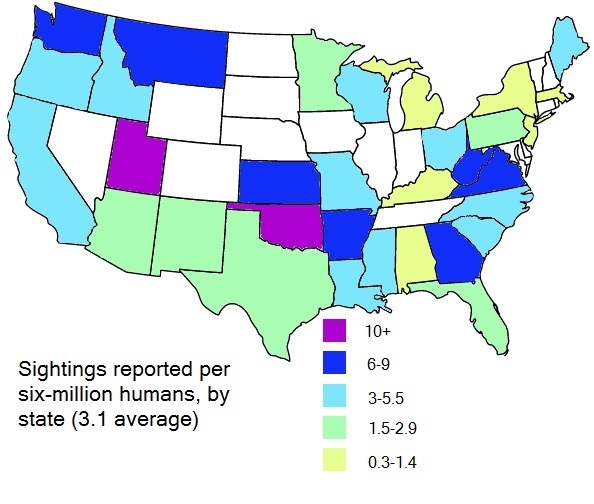
  3. Is this story an isolated report, with no other sighting reports of giant pterosaurs in the USA?

Question #1:

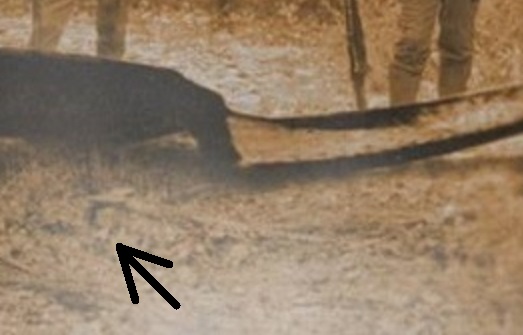
Let’s assume somebody decided to make a hoax photo of a convincing recently-deceased Pteranodon. Using Photoshop, how would a hoaxer make it convincing? Would he use an image of a dugout canoe for the wings of the giant pterosaur? Not likely. Would he use or construct anything looking like an image of dugout canoe? Not likely. He would probably use a sketch of a whole Pteranodon, not piece together strange parts.

Drinnon is not alone, but I find it strange that some skeptics point out small details that they interpret as evidence of Photoshop manipulation (or they have heard a rumor of such) and fail to see the whole picture. Let us be clear: This photo shows a convincing head of a Pteranodon, or similar pterosaur head, with apparent wings that look somewhat like the ends of one or two very pointed dugout canoes. I suggest nobody since the first edition of Photoshop in 1990 would spend hours creating such a hoax to fooling people into thinking that a giant Pteranodon had been killed by Civil War soldiers. Those wings are too strange.

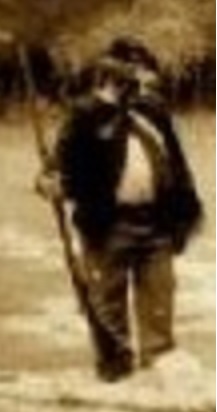
Now consider the implication of Drinnon’s proclamation that the people had halos around them (one evidence of Photoshop manipulation). What would a hoaxer do that would leave that kind of trace? What else than to insert those images of soldiers onto the background. But why go to all that trouble? He could just use an old Civil War photograph that already had soldiers in it.

I see only one good reason for a hoaxer to paste several images of individual soldiers onto a background: to hide the deception from those who might recognize the original photographs of the Civil War. But persons who know those old photographs well—those persons are rare, so the hoaxer must be extremely meticulous in his forgery. In that case, he would avoid making it at all easy for anybody to doubt what appears to be a recently-deceased pterosaur. Now we see the problem that flies in our faces: What weird wings!

Question #2:

According to one site (with which I disagree on some issues), “many people” remember reading a “‘believe it or not’ type book” that was published between 1950 and 1970. I have only a vague memory of it myself. But if one of my associates or I find it in our research, it could blow away any references to Photoshop hoaxing. We’ll see what we find.

Question #3:

Is this apparent encounter with a giant pterosaur an isolated event? Hardly. For the past nine years, I have received eyewitness reports, some of which include descriptions of a huge pterosaur-like animal flying overhead. This fits perfectly well with the concept of some Civil War soldiers being photographed next to the body of a similar creature. If genuine, the photograph would show an encounter in harmony with generations of human experience in North America.

Conclusion

I’ve not yet come to any firm conclusion about the authenticity of this photograph. I’m still keeping an open mind about its age, as well. This photograph, if recorded during the Civil War, could have been a physically contrived hoax, using one or two dugout canoes, and with a Pteranodon head added onto the photo more recently, to amplify the effect. We’ll see.

.

Three photos of possible pterosaurs

Despite the canoe-like wings, photo #3 is the most credible of these three, by far, believe it or not. My intention, however, is not to force this into an all-or-nothing, sure-thing-or-fake, judgment. Assign it whatever credibility you like . . .

.

This past Monday morning I read an email I received from a woman who encountered three “dragons” flying over the I-5 freeway, just northeast of downtown Los Angeles, on Sunday morning, March 3rd. (I will call this anonymous eyewitness “CGP”)

This morning at about 6 am [later clarified to be within five minutes of 6:10 a.m.]  I saw three “dragons” flying over the 5-North freeway between Griffith Park and Glendale. They appeared to be several feet long, with a head:body:tail ratio that was certainly not that of a bird. Their wings were long, angular and pointed and their tails had triangular points. . . . I definitely saw them, but was driving so I could not stop and watch where they went.

I considered non-ropen possibilities but by Thursday the report appeared to me to have indeed come from an encounter with three ropens. A number of factors seemed to counter a hoax possibility and misidentification of birds was shot down by her choice from a silhouette page of birds, bats, and pterosaurs. It was the same page used by Guessman and Woetzel on Umboi Island, Papua New Guinea, in 2004.

.

silhouette page of 34 images of bats, birds, and pterosaurs, used by Guessman and Woetzel on their 2004 expedition on Umboi Island

Silhouette test page: mostly pterosaurs, with some birds and bats

She chose #13 (Sordes Pilosus), the same image chosen by two important eyewitnesses on Umboi Island: Jonathan Ragu and Jonah Jim. I was not shocked, however, for although I have not yet seen one of these wonderful flying creatures myself, I have encountered many reports of others who have encountered them in Southern California. Descriptions do relate to the ropen of Papua New Guinea.

.

sketch of the form of the Sordes Pilosus - a Rhamphorhynchoid (long-tailed) pterosaur

Sordes Pilosus – a “basal” Rhamphorhynchoid pterosaur supposed to be extinct for about 140 million years – was chosen as the creature seen by an anonymous eyewitness in Southern California (March 3, 2013) and by two natives on Umboi Island, Papua New Guinea

.

When I asked her about neck length, she replied:

Yes, that was another thing that tipped me off that they were not birds. They each had a distinct neck between body and head, that was more narrow and clearly visible.

She did not notice any glow from the three flying creatures, but the sky had already begun to brighten (it was just before dawn). Other eyewitnesses in California have testified of observing glowing creatures that fly at night, which supports the idea that at least some apparent pterosaurs in California are bioluminescent.

###

.

Dragon Hunting in Southern California

Some persons might wonder if the woman could drive safely and ask if she had been high on something. Whitcomb asked her how high the creatures were flying above the I-5 and wondered if they had long necks.

Ropen or Pterosaur Sightings

Hodgkinson continues to give a powerful testimony of his 1944 encounter with a huge flying creature that is an obvious live pterosaur, notwithstanding the Western dogma about universal extinction.

Bioluminescence in Pterosaurs

Guessman interviewed Jonathan Ragu, of Mararamu Village, who saw a ropen in July of 2004, when he and his daughter were at a beach. Between 7:30 and 8:00 p.m., with a crescent moon and good visibility, it flew away from the northwest coast of Umboi Island, heading toward Tolokiwa Island . . . Glowing brightly . . . from the head and trailing edges of the wings, it flew fast, at tree-top level.

Sightings of Bioluminescent Pterosaurs?

I just received a sighting report from Tennessee (edited for spelling and quoted in part):

A friend of mine has directed me to you to see if you may have any insight into what my husband and I saw this evening. We were driving home and saw three glowing balls in the sky. . . . My husband said, “hot air balloons,” and that’s just what they looked like but they were moving so fast through the sky. . . .

They were shortly followed by a fourth. . . . Any thoughts?? I live in Knoxville.

That sighting report of “glowing balls” flying through the sky at night in Tennessee—it gives us little to work with. I asked the eyewitness a few questions but the only way to be anywhere near sure that a person is seeing a bioluminescent pterosaur is this: An eyewitness needs to see both a form of a pterosaur and see a glow from that creature.

*

Two years ago I received an email from a man in Miami, Florida:

I’m fairly close to the water . . . I’m also in the path of many airports in my area . . . so I know what airplane lights look like and can always hear an engine. I (along with guests on the second occasion) have seen some unexplained lights, very faint in the air. They looked to be gliding in a very easy manner. It is hard to explain. Regardless, the only explanation I’ve been given is that they’re satellites, but they were too close too the ground. . . . after reading some accounts, I think what I saw was a ropen . . .

That report from Florida also gives us little to work with. I hope that more eyewitnesses come forward from Florida, when this kind of flying light is again observed.

*

Much more telling is a report from Pasadena, Texas. The creatures flew about 100-150 feet above the eyewitnesses:

I have seen them, they look like bats but flap their wings way different than birds do… And they have a red-orange bioluminiscent [sic] body… First time I spotted one was somewhere on Nov, 2011; last time I saw 2 of them together a week ago [March, 2012].

I asked the man, “Were you able to see any wings?” He replied:

Yes of course . . . glowing red-orange, and look like those of a bat

I asked him, “What is the longest that you have seen one, in seconds?” He replied:

The longest I have observed them is between 30 second to possibly a full minute when using binoculars

The sighting in Pasadena, Texas, is far more significant than the other two, for the eyewitness saw glowing wings, indicating it was a bioluminescent flying creature.

Huge Glowing Creature Flying in Southern California

In September of 2009, I received an email from a man who had a sighting, just the previous night, in Sherman Oaks, California (near Los Angeles). He and his girlfriend saw a creature that “baffled” them:

. . . it was so strange . . . it didn’t look like a bird really . . . My girlfriend has 20-20 vision and she told [me], a few minutes later, that it had lights on it. . . . [or] a glow or reflection.

The man estimated the wingspan at 10-15 feet; his girlfriend, at 20 feet.

*

In April of 2010, I received an email from a man in that same area of Southern California. He told me:

[We saw a] bright radiation-like light coming from the belly of this Pterodactyl looking animal. I seen it fly right above us maybe 150-200 feet and this thing wasn’t no bat; it was bigger with large wing span . . .

*

I know of other reports of flying lights in Southern California, lights that have been associated with flying creatures. I also know of many sightings of apparent pterosaurs in Southern California, some of which appear like the ropen of Papua New Guinea: long-tailed and featherless. Making a solid scientific case for bioluminescent pterosaurs in my home state and in other states of the USA—that is a tall order indeed, and it may take many more years to convince biology professors, and scientists in general, to accept extant pterosaurs. But that is what my associates and I are in this for: the long haul.

.

Still from Youtube video of a light reputed to have flown over Winder, Georgia, around 2010

Still from a Youtube video of a purported flying light in Georgia

If the Youtube video is genuine, a strange light was flying over Winder, Georgia, in 2010

.

Nonfiction cryptozoology book on living pterosaurs - back coverLive Pterosaurs in America, in its third edition, by Jonathan D. Whitcomb

Shown above is the back cover of the nonfiction cryptozoology book

.

###

Bioluminescence in Pterosaurs

One night, in April of 1993, near the northwest coast of Umboi Island [Morobe Province, Papua New Guinea], after a large funeral procession arrived at the burial location, a creature with a glowing red tail came from the sea. . . . About two hundred mourners were awake when the creature flew overhead.

Pterosaur Sightings in the United States

RG and his friend, in the late afternoon of a clear day [in Texas], were startled by a flying creature less than 150 feet away. For about fifteen seconds, they watched it fly, about fifty feet high . . . The general appearance was “leathery” and it had a pointed beak and head appendage.

Focused Analysis of Pterosaur Sighting Reports

The heart of this post is an analysis that compares older sightings with newer ones.

Symbolically speaking, the cage enclosing the universal-extinction dogma (for pterosaurs) has appeared solid, rock tight against any escape. But the back of the enclosure, what hardly anybody even thinks about, differs greatly from the facade, not that the back door is unlocked or even wide open: There is no back door. But there is a huge hole for animals to escape, and that’s just what those pterosaurs have been doing for centuries.

Living Nightmare: Attack in the Dead of Winter

Remember your worst nightmare? Were you glad to wake up? Be grateful. In the early morning hours of February 23, 2010, a few miles or so southwest of Marfa, Texas, the victims were terrified by what awakened them.

Last September Aaron Wright interviewed me for an Australian radio-podcast, recorded for audio editing. Here is part of it.

. . . Aaron Wright: So how large are these creatures?

Jonathan Whitcomb:

The largest ones are very rare. But they’re so large that they cannot be mistaken if a person sees one. I’ll give you an example. In Perth, Australia, (I believe the year was 1997), it was in December, a couple was taking a walk. . . . They saw a creature flying up, and eventually they came to the conclusion that it could be as large as fifty-foot wingspan, from tip-to-tip of the wings.

Aaron: Fifty foot!

Jonathan:

But we have a number of other sightings across the southwest Pacific and in other parts of the world, including California in the United States, in which there are rare cases of a very large creature being sited in the daytime.

Just a few years ago, a man was driving in the daylight, in clear daylight, in Orange County, in Southern California, and he was startled to see this creature fly up from the marshy area on his left. It flew over the road—it’s . .  not too far above the road in front of him. And he says that the length from the nose (the front of the beak or whatever it was) to the end of the tail was the same as the width of the road. Now I went out there and I measured it: It was thirty feet. And he said about sixteen feet of that length was tail.

Aaron:

In your opinion, Jonathan, how do you think that these creatures have managed to exist for as long as they have, and yet science still won’t accept that they are actually out there?

Jonathan:

The challenge is still well within the realm of cryptozoology—we have eyewitnesses from around the world—but it’s so much against the common teachings that we have in Western countries like in the United States, for example, and we’re taught from childhood that they’ve been extinct for millions of years: All dinosaurs and pterosaurs are just ancient primitive creatures.

Not everybody believes that. My associates and I—we [have] a very different view. We are not convinced that they are ancient. There’s a major problem in the Western assumptions and origin philosophies. It’s kind of a complicated question.

The pterosaurs that are still living, there are very few species: maybe . . . only three or four species. They just basically keep away from people. . . . We have historical documents that kind of explain that because . . . historical records (some people think that they’re only mythical) but there are legends that indicate that people have gone out and killed these creatures, because they’re just a nuisance, a danger to humans in past centuries.

.

Canadian television show recorded cryptozoologist Jonathan Whitcomb

Whitcomb (left) interviewed for a Canadian television talk show (only indirectly related)

.

Whitcomb on Radio Talk Show in Australia (recorded for a podcast)

Aaron Wright:

Joining me today is Jonathan David Whitcomb, author of Live Pterosaurs in America and a new book which has just come out: Live Pterosaurs in Australia and Papua New Guinea.   Thanks for joining us, Jonathan; how are you today?

Jonathan Whitcomb: Oh, great! Thanks very much for inviting me.

Aaron:

Oh, you’re very welcome. So let’s just talk about ropens . . . and pterosaurs. What are these creatures? I thought they were extinct.

Jonathan:

Most species of pterosaurs have become extinct at some time in the past . . . What we’re trying to portray to the world is that we’ve discovered a large number of eyewitnesses, from different parts of the world, who testify of something that couldn’t be anything other than one or more species of living pterosaur.   I’ll give you an example. In Papua New Guinea, some of the villagers, the language that they speak, they have a word called “ropen,” and that designates a large nocturnal flying creature. And we know from eyewitnesses that it has a long tail, and it has a bioluminescent capacity. It glows for a few seconds at a time at night, as it’s flying.

Pterosaur Sightings

“I know what it was. It wasn’t a heron; it wasn’t a vulture . . .” The eyewitness was shocked to see that the creature had both a head crest (common in Pterodactyloids) and a long tail with a “diamond tip” (common in Rhamphorhynchoids).

Pterosaur Sighting in a Newspaper

. . . Yesterday, Mr Whitcomb and his local guide showed up at the Post Courier office in Lae to tell of his study. He said the stories were not just myth but actual sightings of a real animal and he was there to try to capture it on film.

.

Switch to our mobile site