Pterosaur Eyewitness

For eyewitnesses of apparent living pterosaurs

Browsing Posts in United States sighting

Another eyewitness has given his name to the world; for an American to admit observing an apparent living pterosaur, that is news. Tom Carson, brother to the “Gitmo Pterosaur” eyewitness Patty Carson, had no knowledge of his sister’s 1965 sighting until he spoke with Patty a few weeks ago (the flying creature seen by her was an apparent Rhamphorhynchoid). His three-second encounter was about a year later, in 1966, but in the same area of Cuba: Guantanamo Bay. I’m very grateful for his report and his willingness to allow his real name to be used. The flying creature he saw seems to have been the same species as the one his sister had seen and the one Eskin Kuhn would see in 1971. Tom told me it appeared to have no feathers and was bigger than a pelican. The tail was odd, like one would expect of the shaved tail of a dog. That was how Tom described it.

front cover for nonfiction cryptozoology book, 3rd edition

Cryptozoology book on live pterosaurs

Two things, before leaving the Cuban pterosaurs: Patty Carson’s sketch of the flying creature she saw is soon to be on the cover of the third edition of Live Pterosaurs in America. She feels the beak is not quite right and not connected to the skull quite right, for how she remembers the creature, but the book publication needed to proceed well before Christmas, and it was waiting only for improvements in that sketch. It will have to do.

While talking with Patty on the phone yesterday, she remembered how many large rats were in the coconut trees at Gitmo, when she and her family was there. She now believes that the creature may use its long beak to get into the foliage and snatch rats for snacks. Yummy!

News Media Page on Live Pterosaurs

In a 2009 press release, Whitcomb declared that at least 1400 Americans have seen a living pterosaur between 1980 and 2008. After a number of cryptozoologists objected to the speculative nature of his estimate, Whitcomb maintained that sightings are far more common than the few news reports, in the late twentieth century, would suggest. He emphasized that many of those Americans are reluctant to tell anyone that they have seen a living “pterodactyl.”

News of Live Pterosaurs in New Jersey and Idaho

“In the summer of 2009, I saw something that I didn’t quite understand, in the pinelands of New Jersey. . . . The following year, on the same stretch of highway, I definately saw something clearly and without doubt. . . . I saw a giant bat-like bird, dark brown without feathers, something prehistoric . . . a long thin head, a long tail, [and a] kind of leathery dark brown skin. The body seemed to be the size of a good-sized man; the wind span, maybe 12-15 feet across.”

Aaron Tullock was only eight years old when he encountered what could only be called a ”pterosaur,” in northeastern Texas, in 1995. Although some critics may discount the experience of a child, he has no doubt what he saw. He is now one of a number of pterosaur eyewitnesses who may be interviewed for a film documentary that may be produced within the next eighteen months.

Aaron Tullock’s 1995 Sighting in Texas

In Aaron’s own words, “This thing flew over my head, about eight feet off the ground, and stopped and hovered in mid air. . . . the creature flew from east going west . . . it came from our land across the road, which is a nice mix of oak and pine forest and thick swamp. . . . It stopped in mid air and hovered there by flapping its featherless, bat-like wings, which were about four feet in span, maybe five. It had a tail about three feet long, with the . . . flange on the end . . . no head crest and no feathers at all, although there was kind of a longish bump on the back of the head. . . .”

Many reports of living pterosaurs suggest a nocturnal behavior for the flying creatures, but this sighting differs, for not only was it in daylight, but the apparent pterosaur had distinctive markings of orange and black, colors most useful in daylight.

Texas Flying Creature

Recent analysis of eyewitness data (eyewitness testimonies of apparent living pterosaurs in the United States) reveals many interesting things. California and Texas account for many of the sightings. This may be from a combination of large human populations and large areas of land in which the flying creatures can live.

“. . . what [at first] looked like a . . . tall man . . . [He] turned and I realized that this man didn’t have a face like a man at all!  I froze in fear trying to figure out what I was staring at. . . . I watched . . . black leathery . . .  bat-like wings [unwrapped] . . . I was so scared . . . [it] stared right at me with its large black eyes and walked closer to me (it had been about 40 ft away maybe) . . . it turned its head . . . I realized the shape of its head . . . it somehow looked like a pterodactyl.   . . . it turned its head back to me . . . the thing appeared to just lift off the ground . . . gliding . . . I ran into my house and slammed the sliding glass door behind me . . .”

Even recent criciticms (for example, by the paleontologist Darren Naish) of living-pterosaur research sometimes includes the insinuation of misidentification regarding bats, especially the fruit bat called “flying fox.” A typical sighting of a large long-tailed pterosaur, however, differs greatly from a sighting of a Flying Fox fruit bat. For one thing, at least some critics fail to realize how many sightings of apparent pterosaurs are in locations where this Megabat does not live.

Georgia Pterosaur (from the cryptozoology book Live Pterosaurs in America)

The lady . . . had been trying to find someone who might help her verify the existence of the strange animals that she had seen twice in the past few weeks. . . . Her first sighting was at 7 a.m., the second, 9 a.m., with both mornings overcast. . . .

Fifteen miles of her commute is on a two-lane 55-mph road through woods alternating with pastures . . . on August 27, 2008. She had woken up early and could not get back to sleep, so she left her house at 6:45 a.m., with the sky still overcast from the last remnants of [a] storm. . . . She had driven less than ten miles, just leaving an area of pasture, entering an area of thick woods . . . when an animal suddenly flew from the right, just over the front of her car. Although alone, she yelled, “What the — what — what is that?” She was stunned.

. . . It was the tail; she looked up at a “very long” tail that had a strange shape at the end. . . . a thick almost-heart-shape at the end of the tail . . . “Dive-bombing my car,” is how she described the flight path, as it crossed the highway in front of and slightly above her. “Curved, like a hammer,” is how she described the head, which had a crest that she thought was “solid, not feathery at all.” . . . a smoothly curved head crest.

Obviously what the lady saw near Winder, Georgia, in the summer of 2008, was no Flying Fox fruit bat, even if that species of Megabat lived in Georgia, which it does not. So what about sightings in Papua New Guinea, where those bats live in great numbers?

Hodgkinson-Hennessy Ropen

The cryptid seen in New Guinea, by Duane Hodgkinson in 1944 and by Brian Hennessy in 1971, I have named “Hodgkinson-Hennessy Ropen.” Similarities between the descriptions given to me by these two eyewitnesses struck me as too much for coincidence. . . .

. . . these different lengths of head crest I believe fall within the range of eyewitness error. In other words, the creatures observed by these two men could very well have had the same length of head crest (relative to the size of the head) . . .  it seems likely that the species is the same for the 1944 and 1971 sightings.

Both Duane Hodgkinson and Brian Hennessy were struck by the long pterosaur tail . . .  in a manner of speaking, and Hodgkinson was close enough to make an estimate of tail-length: “at least ten or fifteen feet.” It was obviously not any Flying Fox fruit bat.

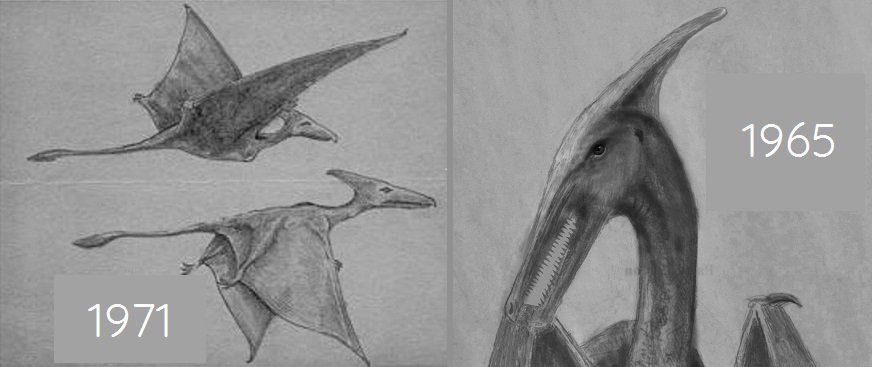
Eskin Kuhn Pterosaur Sighting

Her sighting [Patty Carson] confirms the credibility of the eyewitness Eskin Kuhn, who long ago reported his 1971 encounter. But Patty saw a similar creature in 1965 . . .

Kuhn sketched what he had seen, soon after his sighting (obviously no fruit bat):

sketch of the two pterosaurs observed by Eskin Kuhn in Cuba

My associates and I, including Garth Guessman and David Woetzel, have no confidence in Darwin’s philosopohy of unlimited evolution. In fact, we actively point out weaknesses in that idea. We do not portray a modern living pterosaur as disproof, by itself, of the General Theory of Evolution (unlimited common ancestry); but I believe that it will become part of the evidence that will eventually make it obvious that Darwin’s basic concept was incorrect. The eventual official scientific discovery of modern living pterosaurs will be part of a larger picture of life on earth, a life that did not originate by accident.

My associates and I do not dispute the obvious cases of limited evolution, for example the outward changes that have resulted in many breeds of domesticated animals or the different shapes or sizes of beaks of finches. We do dispute molecules-to-man evolution.

Evolution, Religion, and Extinction of Pterosaurs

“An Evolutionary Boundary” involves simple math, for a biologically saturated environment . . . the population calculations are simple. . . . After about six months of calculations, using computer programs I wrote myself, the original population of organisms of 10e29 (the number having “1″ followed by twenty-nine zeros), after only a few generations, had only a minute fraction of viable candidates for macro-evolutionary change.

Extinguishing Pterosaur Extinction

Examine the Western textbooks in detail. Where do you find any reference to any human experience regarding the extinction of even one species of pterosaur? Such a human experience is completely lacking, and the objection that it is impossible for humans to have witnessed any extinction of any pterosaur—that objection is irrelevant: The assumption of universal pterosaur extinctions comes not from any human experience. The point? How foolish to dismiss all human experiences, from around the world, that contradict a dogma of Western textbooks!

Live Pterosaurs in New Mexico

“It had a 20-30 foot wingspan and was about the same length long. It had a long tail with [a] seeming spike at the end. Its head was very pterodactyl shape with a fluted back pointy head. It glided at about 700 feet . . . and [it landed] somewhere on the southern expanse of Magdalena Mountains.” [in New Mexico]

Pterosaur in Arkansas

“It was probably 1982 when me and my older brother were sitting in our carport [in Texarkana, Arkansas] It was getting dark but there was plenty of light in the sky when we saw what we believe to be a pterodactyle [pterosaur]. The wingspan seemed to be about 25’ to 30’ ft wide. . . . an awesome sight to see.”

Kongamato Cryptid

The boy was walking from one mud-brick hut to another, one night in 1988, carrying a tray of food for family members. As he walked between the huts, he noticed something on the roof of his uncle’s hut. A creature was perched on the edge of the roof, lit up by the nearby porth light. The winged creature appeared to be four-to-five feet tall, olive brown, and leathery with no feathers. A “long bone looking thing” stuck out the back of its head . . .

Lack of Evidence for Extinction

Nothing in any scientific study or in any organized research of science has uncovered any evidence for the universal extinction of all species of pterosaurs. That idea is only a working assumption, regardless of fossils. On the other hand, the many eyewitnesses, from around the world, give evidence for several species of modern living pterosaurs, although most clear sightings involve a long tail like that of a Rhamphorhynchoid pterosaur.

A common misunderstanding, even among paleontologists, is that fossils of pterosaurs can be taken as if evidence for universal extinction. In fact, fossils are evidence of life in the past, not extinctions. And no combination of fossils, however they have been dated and however reliable that dating, can ever prove the universal extinction of a group of unlimited numbers of species, such as pterosaurs. That is unscientific dogma.

________________________________________________________________________

front and back cover for Live Pterosaurs in America, second edition

From readers of first edition of non-fiction cryptozoology book Live Pterosaurs in America (note this is now in the second edition, published late in 2010):

“[The] new book arrived today! . . . a wonderful job!!! . . . more sightings than they can dispute (21 states!!!) . . . a descriptive and engaging ongoing investigation . . .” Susan Wooten, who lives in South Carolina.

“This seems to be the author’s second book on the subject, and this one is worth the effort. He has focused on the accounts of witnesses who saw something, and that adds credibility. The writing is easy to read and he adds comments and analysis . . . more useful.” Red Rabbit, Cleveland, Ohio. [Five stars for the first edition]

“The problem with science is that we think we know it all and that is far from reality. This book shows courage to continue the search. If you have an interest in cryptozoology you should read this.” Dale Reeder, PA.

“This book is a great book! This book contains a lot of sightings and information on living pterosaurs. I highly recommend this book to anyone who is interested in living pterosaurs.” [from Amazon-anonymous child] A Kid’s Review [Five stars for the first edition]

Switch to our mobile site