Pterosaur Eyewitness

For eyewitnesses of apparent living pterosaurs

Online references to the “demon flyer” of Papua New Guinea are easy to find; but finding both clear thinking and dependable knowledge in this area is not so easy.

Ropen: a Demon Flyer?

. . . a brief Google search makes me suspect that the island of ”Rambunzo,” by that spelling, does not exist in Papua New Guinea; perhaps it is a misspelling, for the first few pages of Google searching refer [only] to cryptozoology sites and Wikipedia has nothing by that spelling. But if this is a misspelling of “Rambutyo,” (near Manus Island) we need to consider what at least some of the people of the northern islands of Papua New Guinea call the large nocturnal flying creature : “kor.” My contact person in that part of PNG is clear about that word for what Umboi Islanders (to the south) call “ropen.” “Kor” is their word, which I suspect is used by the people of Rambutyo.

That post gives many more details on this use of the phrase “demon flyer” in referring to the flying creature that is called by a number of names in Papua New Guinea. I’ll add here what was left out there.

On Umboi Island, at least some of the villagers have a different perspective on the concept of spiritual beings, at least different from many Americans. An intelligent being need not be either 100% spirit or 100% physical. The ropen of Umboi, according to Darius (who recited native traditions to the American explorer Paul Nation, in 2002), is like a spirit but also like a man. It flies around at night and sometimes comes down from a mountain to hunt game animals. To many islanders, this being may appear to be both spiritual (flying) and human (hunting animals for food).

In addition, natives may have a more complex concept of spirits than most Westerners have. A spirit, to them, need not be either 100% good or 100% bad. In that sense, at least, “demon flyer” seems a poor translation for a word that probably does not have a purely negative connotation for them.

Addendum

Marfa Lights Explanation

We need to consider the apparent intelligence in the movements of those CE-III Marfa Lights, for sometimes some things are exactly as they appear to be, in this case, intelligent.

Nonfiction cryptozoology book on living pterosaurs - back cover

The third edition of Live Pterosaurs in America (published in this version in November of 2011) is available on Amazon.com and from some other book sellers.

From the third paragraph of the back cover:

Americans, for years, have reported obvious living pterosaurs, with sightings in Washington state, California, New Mexico, Texas, Ohio, Arkansas, Oklahoma, Georgia, Florida, South Carolina, Rhode Island, Maine, New York, Pennsylvania, Kentucky, Virginia, Kansas, Indiana, Wisconsin, Michigan, and Missouri.

Who is an expert on live pterosaurs? Only a few nonfiction books and maybe two scientific papers have been written on modern living pterosaurs, so what makes a person an expert? Probably no college or university offers even one class on this narrow niche of cryptozoology, so let’s define an expert as one who has interviewed at least three eyewitnesses of apparent living pterosaurs (or been directly involved with at least three interviews), since the beginning of this century.

Please excuse the repetition, but we also need to review some of the names for modern pterosaurs (English-language and otherwise):

Pterodactyl, dragon, flying dinosaur, prehistoric bird, dinosaur bird, ropen, indava, seklo-bali, wawanar, kor

Exploring Papa New Guinea

The following four Americans have explored in Papua New Guinea, within the past eleven years, searching for living pterosaurs in remote tropical rain forests. This is not an all-inclusive list but few other cryptozoologists, if any, have given nearly so much of their time in this kind of search. I list these adventurous explorers in order of when they first interviewed eyewitnesses in Papua New Guinea.

Paul Nation

This expert in ratites (flightless birds like ostriches) first became involved in ropen searches by accompanying Carl Baugh (who no longer searches for living pterosaurs) on an expedition on Umbi Island, PNG. In 2002, Paul took his son Nathanael to Umboi, where they talked with many natives but saw no ropen.

Paul was instrumental in helping organize the two ropen expedition of 2004, both of which were searches on Umboi. He was unable to go along that year but had his own expedition with Jacob Kepas, late in 2006, deep in the mainland of Papua New Guinea. That expedition resulted in one daylight sighting of a giant indava by Kepas and several nighttime indava-light sightings by Nation. The video footage recorded by Nation in 2006, showing two glowing objects near the top of a ridge near Tawa Village, was found to be strange: not any camp fires or airplane lights or flash lights or meteors any other commonplace explanation.

On the sideline, the indava lights are seen just south of the area where the British biologist Evelyn Cheesman saw strange flying lights in the 1930′s. But the duration of the lights Cheesman saw relate more closely to the ropen lights of Umboi than the indava lights, even though Umboi is further away and in a different environment (coastal reefs for ropens to fish rather than deep jungle interiors).

Jonathan Whitcomb

With the advisory help of Paul Nation, Whitcomb was able to embark on his own expedition on Umboi Island, in 2004. Like David Woetzel, he eventually wrote a scientific paper in a peer-reviewed journal of science, on this subject. Whitcomb has written two books (in multiple editions) and about a thousand web pages and blog posts on living pterosaurs. A few of his web pages are non-English including French, German, Hungarian, Spanish, Japanese, and Polish. He receives emails from eyewitness from around the world and may be the world’s leading expert in worldwide sighting reports. He may be the only cryptozoologist who devotes anything close to a full-time effort, six days a week for eight years, to the subject of living pterosaurs. His controversial ideas have been noted in various newspapers, mostly American, including the Houston Chronicle.

Garth Guessman

With David Woetzel and native Jacob Kepas, Garth Guessman explored Umboi Island, Papua New Guinea, searching for ropens. Just a few weeks after the Whitcomb expedition, these three explorers interviewed many islanders, most of whom had not been interviewed by Whitcomb.

According to Creationwiki:

Guessman’s knowledge of Rhamphorhynchoid pterosaur fossils allowed him to notice an important clue about the ropen‘s classification [being the same kind of flying creature]. [Guessman and Woetzel] learned that the native traditions describe the ropen‘s tail as being stiff, never moving except near where it connects to the body. Guessman recognized that this relates to the stiffening extension rods of Rhamphorhynchoid vertebrae: all but a few vertebrae are locked into stiffness; the few that are flexible are near where the pterosaur’s tail connects to the body.

Guessman has lectured in church and creation-association meetings and continues to support the concept of modern living pterosaurs and their relevance to the origin of life.

David Woetzel

Cameroon Expedition in Africa

They call it li’kela-bembe, and they revere it for its fierce reign over the Boumba river. They have never told a soul about this muscled beast that feasts on molombo fruit and pummels crocodiles with its serpentine tail – because nobody ever asked.

Nobody, that is, until last November, when Concord businessman David Woetzel went crashing through the virgin forests of Cameroon on the trail of this much-rumored but ever-elusive modern-day dinosaur. Now, thanks in part to Woetzel, this mysterious li’kela-bembe may be roaming into range of a camera lens for the first time.

But David Woetzel has searched jungles other than in Africa and for creatures other than dinosaurs (pterosaurs are scientifically classified as being seperate from dinosaurs). Although he never saw the dinosaur in Africa, he did see the ropen light in Papua New Guinea.

Woetzel Sees the Light on Umboi Island

“My sighting was so quick that it was impossible to get a video—maybe 2 seconds  . . . almost golden and shimmering around the edges. It looked like an old-fashioned street light in the fog. There was no tail and it was flying horizontal from  Mt. Barik toward  Mt. Tolo.” (Woetzel was interviewed by Jonathan Whitcomb soon after this sighting)

Live Pterosaurs in America (third edition of the nonfiction book by Jonathan David Whitcomb)

About eyewitness accounts of living pterosaurs, Jonathan Whitcomb has written more books, more web pages, and more blogs than any other person on earth. . . . After interviewing many natives [on Umboi Island, in 2004], he returned to the United States convinced of the identity of the ropen: a living Rhamphorhynchoid pterosaur; but he did not return to his former profession: He became a writer, proclaiming to the world that pterosaurs are still living.

Traditional news media writers, in the past, have given us detailed (or not-so-detailed) accounts of apparent encounters with “dragons” or “pterodactyls,” although the article in the mid-ninteenth-century Illustrated London News now seems highly suspect, regarding its origin. But more recent news writers have also commented on sightings of possible pterosaurs.

Author Tracks Pterodactyls Among Us

Matt Coker, in a December, 2010, post on a blog for a California newspaper, mentioned my conjecture about the Marfa Lights of southwest Texas (I’m still not nearly 100% certain about bioluminescent pterosaurs causing some of the Marfa Lights; we need more close-sightings).

Jonathan Whitcomb is actually based in Long Beach, where as a cryptozoology author he offers an explanation of the mystery lights of Marfa, Texas, and Papua New Guinea. Human inhabitants in both places have observed in the sky balls of light that seem to split into two, fly away from each other and then turn around and fly back together.

Such sights have produced legends about dancing devils or ghosts and scientific explanations involving lightning or earthlights. Whitcomb has a far different explanation: bioluminescent predators flying together . . .

Of course the subject of flying predators causing CE-III Marfa Lights is a deep subject, too deep for most news articles.

Live Pterosaur Media Center

This online “media room” or “press room” makes it easier for news writers to gather together the information and images they need regarding sightings and investigations of apparent living pterosaurs.

Contrary to what many paleontologists believe, some cryptozoologists, including Jonathan Whitcomb of Long Beach, California, believe that one or more species of pterosaurs are still living, although most, at least, seem to be nocturnal and uncommon. For eight years, Whitcomb has gathered and analyzed eyewitness reports from around the world, including North America. He has concluded that a number of species of pterosaurs still live on the earth.

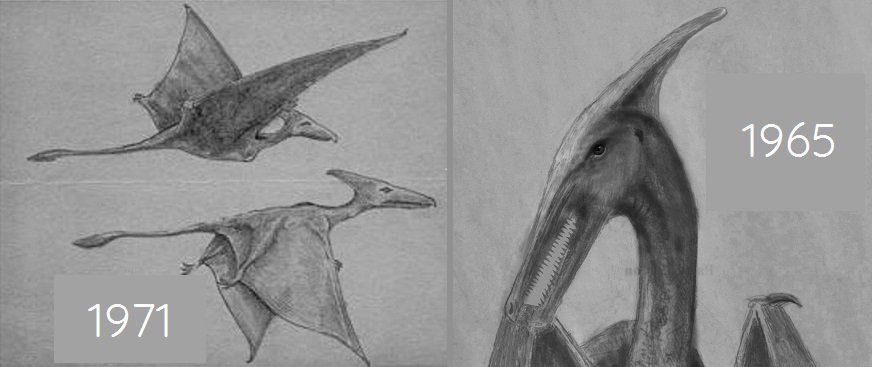
Another eyewitness has given his name to the world; for an American to admit observing an apparent living pterosaur, that is news. Tom Carson, brother to the “Gitmo Pterosaur” eyewitness Patty Carson, had no knowledge of his sister’s 1965 sighting until he spoke with Patty a few weeks ago (the flying creature seen by her was an apparent Rhamphorhynchoid). His three-second encounter was about a year later, in 1966, but in the same area of Cuba: Guantanamo Bay. I’m very grateful for his report and his willingness to allow his real name to be used. The flying creature he saw seems to have been the same species as the one his sister had seen and the one Eskin Kuhn would see in 1971. Tom told me it appeared to have no feathers and was bigger than a pelican. The tail was odd, like one would expect of the shaved tail of a dog. That was how Tom described it.

front cover for nonfiction cryptozoology book, 3rd edition

Cryptozoology book on live pterosaurs

Two things, before leaving the Cuban pterosaurs: Patty Carson’s sketch of the flying creature she saw is soon to be on the cover of the third edition of Live Pterosaurs in America. She feels the beak is not quite right and not connected to the skull quite right, for how she remembers the creature, but the book publication needed to proceed well before Christmas, and it was waiting only for improvements in that sketch. It will have to do.

While talking with Patty on the phone yesterday, she remembered how many large rats were in the coconut trees at Gitmo, when she and her family was there. She now believes that the creature may use its long beak to get into the foliage and snatch rats for snacks. Yummy!

News Media Page on Live Pterosaurs

In a 2009 press release, Whitcomb declared that at least 1400 Americans have seen a living pterosaur between 1980 and 2008. After a number of cryptozoologists objected to the speculative nature of his estimate, Whitcomb maintained that sightings are far more common than the few news reports, in the late twentieth century, would suggest. He emphasized that many of those Americans are reluctant to tell anyone that they have seen a living “pterodactyl.”

News of Live Pterosaurs in New Jersey and Idaho

“In the summer of 2009, I saw something that I didn’t quite understand, in the pinelands of New Jersey. . . . The following year, on the same stretch of highway, I definately saw something clearly and without doubt. . . . I saw a giant bat-like bird, dark brown without feathers, something prehistoric . . . a long thin head, a long tail, [and a] kind of leathery dark brown skin. The body seemed to be the size of a good-sized man; the wind span, maybe 12-15 feet across.”

Switch to our mobile site