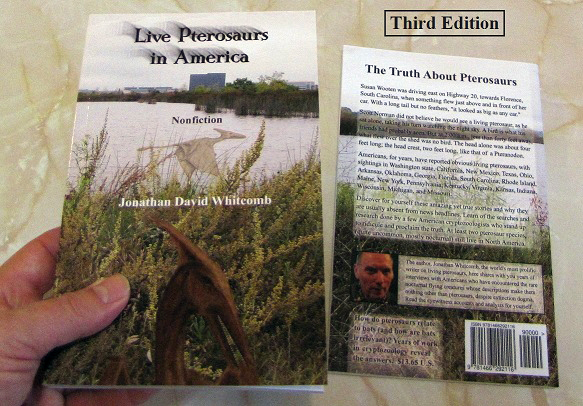


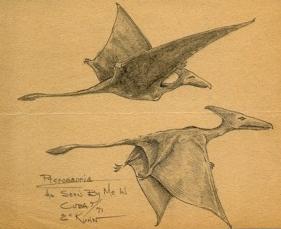
Eyewitness Accounts of Modern Pterosaurs in the Southern States
By the living-pterosaur expert Jonathan Whitcomb (author of books on extant pterosaurs)
UPDATE: To encourage practices of internet security and to support those online sites that are safe, this post on encounters with non-extinct pterosaurs has been updated with “https” in the URL’s of its links.
The online Living Pterosaurs proclamation gives the following American states in the South, among many U.S. states, as places where eyewitnesses have seen apparent non-extinct “pterodactyls,” by whatever name those persons used for the flying creatures (sometimes using the word “dragon”):
- Alabama
- Arkansas
- Florida
- Georgia
- Kentucky
- Louisiana
- Mississippi
- North Carolina
- Oklahoma
- South Carolina
- Texas
- Virginia
Pterosaur Sighting in Raleigh, North Carolina
I received the following email in February of 2014. It’s edited here for standard English (“b4” in the original means “before”), with a small part of it being deleted. The eyewitness reported two sightings: in 2003 and in 2007.
I have been telling this . . . to my family for the past 10 years. I was coming from work, walking down Cross Link Road, going towards Garner Road, and I saw this huge (what I thought was a) bird, but it was not any bird I had seen before. I stopped walking and watched it until I couldn’t see it anymore. Cars where just driving by; nobody even noticed (2003).
In 2007, I was on Bragg Street and I heard the trees ruffle and that same thing flew from one side of the street to the other. It was beside the bike trail before you get to Central Women’s Prison. I knew I wasn’t crazy: This time a guy at the other end looking towards me saw it [at] the same time. We just stared and both said, “Did you see that?” GOD as my witness, I saw this. . . .
It didn’t flap its wings like a bird . . . more like back peddle like a bat, then it soars out and repeats to get more speed. I hope one day someone gets more info. I wish I had my cell with a good camera then. Thanks for your time.
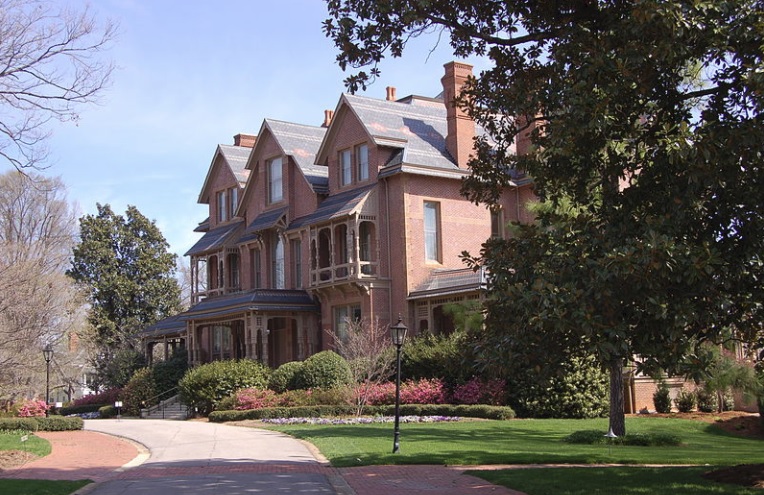
Governor’s Mansion in Raleigh, North Carolina (photo in public domain)
.
Pterosaur Sighting in Edmond, Oklahoma
In June of 2014, I got the following two emails:
I believe I saw a pterosaur last night in Edmond, Oklahoma, just north of OKC. . . . Today I was trying to look up other recent sightings and was shocked to see that two other people have seen something similar in my state.
. . . my friend that was with me immediately said “Is that a dragon!?” It had a long tail, pointed wings straight to the side, short head. I thought it was a giant bat, but it would have to be the largest bat in the world. I didn’t want to report it as I didn’t think it would matter. But seeing that others have had recent sightings in Oklahoma, I felt obligated to do so.
The sighting was almost close to 9 pm, right before sunset. It was dark but not too dark and I got a really good look at it because it flew right over the car and I was able to see the exact shape of the creature from underneath. It was out in the country, I live in a very rural area.
We were driving and I was the one who saw fly out of the tree and instantly I could tell something was different because of the way it flew. It is hard to describe, all I can say is it flew very “majestic” like, almost like a dragon. Slow wings.
Notice that both sighting reports mention the word bat. That can shoot down a misidentified-bird conjecture.
###
.
Living Pterosaurs in Louisiana
Last night, I got a phone call from a Ryan Causey, who had a sighting in 1994 in southern Louisiana. The flying creature was seen late at night as it flew over the Lake Pontchartrain Causeway bridge . . .
.
Pterosaurs sightings in Oklahoma and in West Virginia
This happened to me about an hour ago. My dad, my baby sister, and I were outside in the hot tub. . . . giant winged creature flying across the sky . . .
.
Brief reviews of five nonfiction books about these wonderful flying creatures
.
- Ender’s Game
- Searching for Ropens and Finding God
- Common Sense (by Glenn Beck)
.
Fear not the light of unfamiliar hue
Washing sand at first
Then penetrating the depths
It bids a hidden feast emerge at last
.
Pterosaur sighting in Bethany, Oklahoma
. . . on two occasions have seen a huge winged creature that had no feathers, gray leathery skin. It looked like the pictures I have seen of pteradactyls.
.
Pterosaur Sighting in Raleigh, North Carolina
I was going over a report of a pterosaur sighting in North Carolina and noticed similarities with Susan Wooten’s sighting in South Carolina.
.
Sometimes an eyewitness will say “giant bat.” We need not assume the flying creature was literally a bat. In Western cultures, the idea of universal pterosaur extinction is so deeply ingrained that eyewitnesses find it difficult to use that word [pterosaur], for it makes them feel unbelievable.
.