Pterosaur Eyewitness

For eyewitnesses of apparent living pterosaurs

Browsing Posts tagged book

Last week, an Amazon book review shocked me, not so much because somebody wrote a negative review of one of my books but because it appeared at first to have been written about a different book, not mine. After reading over, several times, the comments by “WS,” I came to better understand why his book review appeared unrelated to Live Pterosaurs in Australia and in Papua New Guinea. WS had become upset because his comfortable assumptions about one or more popular standard-model axioms of science had been challenged in his reading of my book.

Definition of “Science”

It appears that WS’s personal definition of “science” includes something like this: All dinosaurs and pterosaurs became extinct millions of years ago. He wrote nothing like that in his book review, so how did I come to that conclusion? Notice what he did write:

“A large portion of it is devoted to the author’s antiscience rhetoric . . .”

“Rhetoric” is a word sometimes chosen by someone offended by another’s words, and it is used to belittle ideas with which one disagrees, therefore we can dispense with that word after acknowledging that WS disagrees with something I have written.

I have found some clues that suggest WS has been careless in his reading and thinking. If he had looked more closely at the Amazon Book Description, he would have noticed this: “Learn for yourself what many scientists never imagine.” The book contradicts a common assumption held by many scientists. (I’m sure many purchasers of many Amazon books fail to read all the contents of the Book Descriptions; WS may be typical.)

Of course I could have been more careful myself, in writing that Amazon Book Description, making it easier for potential readers to know that the subject is controversial and contrary to deeply held assumptions about extinction. But WS seems to have also been careless while reading the book.

Perhaps the following paragraph in the book can help explain why WS chose the word “antiscience:”

Some eyewitnesses fear discovering the monstrous possibility of personal insanity. Others fear not insanity itself but the opinions of anyone who might think them insane. Others fear discovering that some of what they had been taught about science was false; they prefer to believe that scientific proclamations must always be true. How grateful I am for those who, in spite of their fears, report to me their encounters!

I believe that WS read the sentence that included “scientific proclamations” and realized I was fighting against one or more of those proclamations, so that reader concluded that I was against science, in other words my writings are ”antiscience.” But how great is the difference between scientific proclamations and science!

Any scientist can proclaim a new idea, be it classified as a conjecture, hypothesis, or theory. What if that idea contradicts a popular idea held by many scientists? Such a submission of an idea does not mean that the scientist has become transformed into an anti-scientist. In fact, holding too firmly to a scientific axiom might actually be a problem, especially if significant evidence appears to contradict the axiom.

I believe that WS was unprepared for the book Live Pterosaurs in Australia and in Papua New Guinea. He was unwilling to consider the possibility that a popular axiom of biology might be faulty or just plain wrong.

Four Chapters - Four Sightings

Table of Contents for a nonfiction cryptozoology book about sightings of pterosaurs in the southwest Pacific


This reviewer of my book Live Pterosaurs in Australia and in Papua New Guinea wrote this:

“The book really consists of one or two intriguing reports . . .”

Let’s move away from WS’s personal opinion about what is or is not “intriguing,” for his statement about numbers of reports can seriously mislead people who read his book review. Four of the chapters shown in the above image of the Table of Contents are each devoted to a sighting report; those are the key sightings, critical to understanding the credibility of pterosaur sightings in general. The book also contains other sightings, a good number, notwithstanding WS’s statement about “one or two.”

The four key sightings (each with a chapter of its own) are these:

  • The Finschhafen Pterodactyl
  • The Bougainville Creature
  • The Lake Pung Encounter
  • The Perth Creature

Here’s a part of what’s found in the chapter “The Bougainville Creature:”

The creature I saw one early morning in Bougainville is etched in my memory. . . . I actually heard it before I saw it. A slow flap…flap…flapping sound. The air was still, and our truck had stopped on our downward journey from the top of the range to the coast way below. The sound was amplified by the road-cutting into the mountain. That is, there was bare red/orange clay, rather than the surrounding jungle.

I can’t remember why our vehicle had stopped. Maybe we had to wait for another vehicle to pass us. I don’t know. But I can still hear that slow flapping sound in the stillness of an early tropical morn, on the road from Panguna down to Loloho on Bougainville Island in 1971.

When I looked up . . . I saw a very unusual creature. Firstly, it was very big (wingspan at least 2 metres, probably more . . . possibly much, much more). I can’t remember the exact distance estimate that this creature was from me . . . It was black or dark brown. I had never seen anything like it before. It certainly looked prehistoric, in that it did not look like any other bird that I have seen before or since.

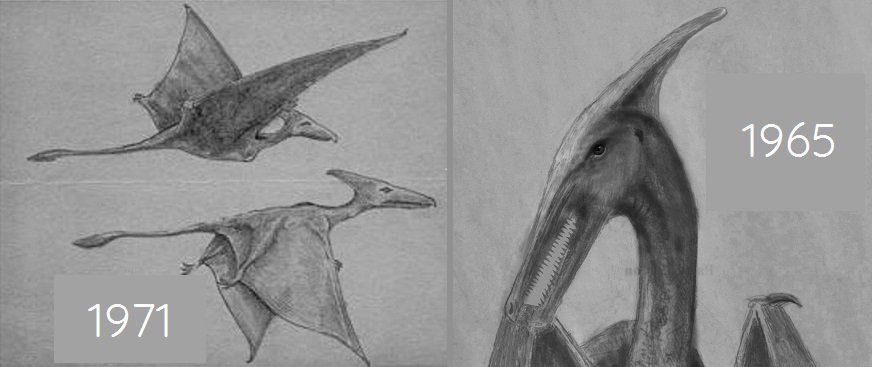
Why prehistoric? Well, maybe my memory has been influenced by the intervening years, but I recall seeing this creature with a longish narrow tail . . . the head was disproportionately large compared to the body (no feathers in sight). The wingspan was large. The head had no ‘normal’ beak. Rather there seemed to be . . . a kind of beak that was indistinguishable from the head, and the head seemed to continue this ‘point’ at the back of the head. There was a clear line running from the ‘beak’ to the back of the head..where the ‘line’ continued to protrude . . .

For those who were previously unaware of the eyewitness in this sighting, don’t assume Brian Hennessy is crazy for seeing such a thing. Mr. Hennessy is himself a professional psychologist.

###

Commenting on a Review of a Pterosaur Book

Consider WS’s declaration: “The book really consists of one or two intriguing reports . . .” Without the word “intriguing,” that statement is patently false. With the word, WS is declaring his opinion or his personal interest in a small portion of the sighting reports. But WS’s statement can be misleading, for no mention is made about the many sighting reports investigated in the book, the many reports that he personally does not find intriguing.

.

cover of "Live Pterosaurs in Australia and in Papua New Guinea"

Non-fiction cryptozoology: Live Pterosaurs in Australia and in Papua New Guinea

Part of the Preface:

You will here find reports of encounters with apparent living pterosaurs, including many accounts never before published in any book. Other sighting reports are condensed from the print book “Searching for Ropens.” The ebook you are now examining is neither exhaustive nor rudimentary, but it explains most of what most Australians, and others, need to know about what might, on rare occasions, fly over their heads at night.

.

Live Pterosaurs in Australia and in Papua New Guinea, my third nonfiction cryptozoology book, differs in being published only in electronic form: Amazon Kindle format. It’s also shorter, about 76 pages, making it much less expensive than the average cryptozoology book: $3.99.

Before quoting from the book, let’s consider an example of Western indoctrination. My wife runs a child care business where many of the preschoolers come early. This morning, a thirteen-month-old boy was feeling sleepy, so he was put to bed with a children’s educational television show playing on low volume. Just as two other preschoolers (a three-year-old and a two-year old) were about to come into the room, the man on the children’s show displayed a picture of a dinosaur and said, “All dinosaurs are extinct.”

From the first chapter:

By the middle of the twentieth century, school teachings had cemented the ancient-extinction idea into Western culture, so dinosaurs and pterosaurs were portrayed as living only in science fiction and dragons only in fantasy. Expeditions in central Africa, searches for a sauropod dinosaur, were the rare exception, with no official discovery. . . .

. . . I don’t blame anybody for simply assuming that their ancient extinction is scientific truth, for we’ve been taught that idea all of our lives. Real science, however, progresses, and progress means change, even when it shocks us. . . .

. . . As you read the following chapters, consider the following perspective. What eyewitness reports should we expect, should uncommon nocturnal pterosaurs live in the southwest Pacific? I suggest that sightings would be relatively few and mostly at a distance and under less than ideal viewing conditions; only a small percentage of encounters would convince eyewitnesses that they had seen a living pterosaur. . . .

The Preface, at the beginning of the book:

Preface to this nonfiction cryptozoology book about modern pterodactyls

Living Pterosaurs in Australia

Even if you’ve never been in Australia or in Papua New Guinea (PNG), you might live within a culture similar to a culture in one of those two countries, regarding disbelief or belief in modern living pterosaurs or in flying dragons . . .

Ebook “Live Pterosaurs in Australia and in Papua New Guinea”

Featherless creatures fly overhead, in Papua New Guinea and in Australia. This nonfiction gives you up-to-date eyewitness reports, informing you why these creatures are still alive and why they are so rarely reported in newspapers.

 Number One Selling Cryptozoology Book

  1. Live Pterosaurs in Australia and in Papua New Guinea
  2. There’s Something in the Woods
  3. Destination Truth
  4. Caverns, Cauldrons, and Concealed Creatures
  5. Real Monsters, Gruesome Critters, and Beasts from the Darkside

I have neglected writing many blog posts, of necessity, over the past few days, for my newest nonfiction book needed much editing and formatting before being sent to Amazon. Live Pterosaurs in Australia and in Papua New Guinea will soon be available for purchase online, at least on the Amazon-Kindle store. Marketing will be focused on Australia, so the spelling (“metres,” for example) is adjusted for Down-Under. But Americans should have no trouble with this nonfiction cryptozoology ebook.

"Live Pterosaurs in Australia and in Papua New Guinea" front cover

The Amazon processing normally takes at least twelve hours or so, making the earliest date for purchase around September 9, 2012.

Promotional materials include the following (here quoted in part):

Featherless creatures fly overhead, in Papua New Guinea and in Australia. This nonfiction gives you up-to-date eyewitness reports, informing you why these creatures are still alive and why they are so rarely reported in newspapers.

Why do these large long-tailed flying creatures sometimes appear in daylight, when they are nocturnal? Why do natives in Papua New Guinea report their encounters but Australians rarely talk about them? Get the details from the world’s most prolific nonfiction author on this subject of modern living pterosaurs.

Update: My cryptozoology ebook is now available, for $3.99 (U.S. dollars) on Amazon, as a Kindle book: Live Pterosaurs in Australia and in Papua New Guinea. It has been submitted as a potential “Kindle Single.”

Australian Pterodactyls

But most of the Australian sightings in the new book have never been published before in any book, and there are at least two new ropen sighting reports from Papua New Guinea.

My newest book is nearing completion: Live Pterosaurs in Australia and in Papua New Guinea. This ebook should be published next month (Sep-2012), with much of the marketing focused on Australian readers. I here include samples, even though the editing is not yet complete.

Some of the sightings mentioned in this book had not been published in any book before, to the best of my knowledge; they are first-hand accounts given to me over several years.

Introduction

. . . I don’t ask that you launch your imagination to fly with each eyewitness report you begin to encounter in the following chapters. When somebody sends me an email about a strange flying creature, I don’t jump onto the first paragraph as if the creature had to have been a living pterosaur; neither do I dismiss the whole account when I first encounter something unexpected. Please do the same: Judge not too quickly, either to one side or the other. . . .

How can pterosaurs be alive? – Chapter One

. . . The first discovery of a pterosaur fossil by a Western scientist, in 1784, was decades before Charles Darwin began writing about his ideas on extinctions and evolution. Before Darwin, Western scientists had assumed that all species of pterosaurs were extinct for a simple reason: Those who discovered the fossils had no experience with any similar animal that was living. . . .

The Finschhafen Pterodactyl – Chapter Two

. . . the two soldiers were fascinated by ants much bigger than those in the States and startled by a wild pig charging through the grass: nothing outlandish. The giant creature that flattened the grass with its wing beats, however—that divided the two soldiers, for Hodgkinson wanted to talk about the “pterodactyl,” but his buddy preferred to pretend they had no encounter. . . .

The Bougainville Creature – Chapter Three

“Thank you, Brian. Your description reminds me of other accounts in the Southwest Pacific. May I ask some questions?”

Q: “Was anything coming out the back of the head (Whether classified as a crest, appendage, horn, or comb)?”

A: “It was like a horn.”

Q: “Can you remember the wing-flapping well enough to estimate the frequency? Thinking of one cycle as the time it takes for the wings to go up and also go down, how many seconds did it take for one cycle (up-and-down-flap)?”

A: “Estimate every 2 seconds.”

Q: “Was the tail straight? (Was any bending of the tail visible?)”

A: “As far as I can recall, straight.”

The Perth Creature – Chapter Six

The creature seen flying over Perth in December of 1997 may not have been the same species as the one seen by Duane Hodgkinson in New Guinea in 1944 or the ones seen by natives on Umboi Island, for the Perth creature seems to have had a short neck. But it appeared to those two Australians as a real living creature . . .

Switch to our mobile site