Pterosaur Eyewitness

For eyewitnesses of apparent living pterosaurs

How delighted I was, this past March, to receive an eyewitness report of three “dragons” flying over the I-5 freeway in Los Angeles! I waited for weeks, hoping another driver on that stretch of freeway just east of Griffith Park, Los Angeles, would confirm the March 3rd flyover; but it would be in vain, for nobody else confirmed it.

How delighted I was, earlier this month, to received an eyewitness report of a “pterosaur” flying over that same stretch of freeway just east of Griffith Park! It was an unexpected but welcome confirmation from another credible lady who also showed no sign of playing a hoax or misidentifying any kind of bird. These two sightings were ten weeks apart and about 1.5 miles apart, near the Los Angeles River channel.

Let’s compare these two sightings of apparent pterosaurs in 2013 in Los Angeles.

Time of Sighting

  • March 3rd, at 6:10 a.m.
  • May 13th, at 4:00 p.m.

General Labeling

  • Three “dragons”
  • One “pterosaur”

Location on the I-5 Freeway

  • Near Colorado Street exit (from northbound I-5)
  • “Right before the Los Feliz exit” (from northbound I-5)

Misidentified-bird Possibility

  • “A head:body:tail ratio that was certainly not that of a bird”
  • “I’m almost positive . . . NOT a bird of any kind”

Direction of Flight

  • South
  • Northeast

Manner of Flight

  • No wing flapping
  • “The wings . . . never flapped. It glided . . .”

Presence or Absence of a Tail

  • “Tails had triangular points . . . [tails were] long and thin”
  • Unknown—eyewitness was concentrating on the head

Head Crest

  • Unknown – eyewitness saw the undersides of the three creatures
  • “I did see its head crest”

Color

  • “Light in color – white, gray or light green.”
  • “membranous charcoal gray/teal undertone skin” (may be referring to head)

.

Near the Colorado street exit from the northbound I-5 freeway - near where three "dragons" were seen flying on March 3, 2013

Los Angeles River, near where three “dragons” were observed flying on March 3, 2013

.

Los Angeles River, just south of where an eyewitness saw a "pterosaur" flying over the I-5 freeway at 4:00 p.m.

Los Angeles River channel, near where an eyewitness saw a “pterosaur” on May 13, 2013

.

Press Release: Griffith Park Pterosaurs

Devin Rhodriquez was driving north on Interstate-5, near Griffith Park in  Los Angeles, when she was startled to see something strange gliding over  the freeway, unlike any bird, more like a “pterosaur.”

Griffith Park Dragons

This past Monday morning I read an email I received from a woman who encountered three “dragons” flying over the I-5 freeway, just northeast of downtown Los Angeles, on Sunday morning, March 3rd.

.

At a list price of $75, the Encyclopedia of Cryptozoology is not for everybody, but for cryptozoology readers who visit libraries it is priceless; I found a copy in the main branch of the Long Beach (California) Public Library. This is one of the twelve reference works awarded special acclaim, in 2006, by the American Library Association; regarding the selection process, the RUSA states, “The titles . . . represent high-quality reference works that are suitable for small to medium-sized libraries.”

Keep in mind the publishing date: January 6, 2005, just a few weeks after the two ropen expeditions of 2004. The book was surely written before the author, Michael Newton, had any reasonable opportunity to become aware of critical new insights that my associates and I had obtained in those two expeditions. In addition, much more has been learned since 2005.

An astonishing 2744 cryptids are included in this massive reference work, from accounts and stories and resources from around the world; a few of those suggest modern living pterosaurs. Please do not judge this book negatively because of the insights gained within the last nine years, regarding the ropen of Papua New Guinea and similar pterosaur-like cryptids in the southwest Pacific. Encyclopedias are not expected to remain completely up-to-date forever.

.

Nonfiction book by Michael Newton: Encyclopedia of Cryptozoology, A Global Guide - copyright 2005 - published by McFarland & Company

Encyclopedia of Cryptozoology – A Global Guide (by Michael Newton)

.

Geography

Let’s consider new insights, regarding the ropen; but we first need to be clear about geography. Papua New Guinea (PNG) is now an independent state, a nation that includes the eastern portion of the island of New Guinea (the second-largest island in the world). Sometimes the three-word designation for the country is used incorrectly, as if it designates a particular island, which is does not. When you want to refer to the largest island in that part of the world, regardless of political boundaries, just say “New Guinea.”

When you’re in PNG (literally or in conversation) and you want to refer to the main area of that country (the eastern part of the island of New Guinea), just say “the mainland.” The western area of that island is part of another nation and that is another subject.

Ropen of Umboi Island

Westerners use the name “Umboi” for what people of PNG now call “Siasi,” or “Big Siasi.” (I noticed a couple of mispellings for “Umboi” in the Encylopedia of Cryptozoology.) Some villages on that island use the word “ropen” for the large glowing creature that flies around at night. I know of no other island in which a local language uses that word in that way, contrary to what seems to have come from sources that contributed to this encyclopedia.

The word “ropen” is surely not a compound word formed from “demon” and “flyer,” whatever the original language involved (although some native, years ago, may have used “demon flyer“ as a quick answer for an inquisitive Westerner); Michael Newton does not explicitly state that in his cryptozoology book, but something like that could be implied.

Unfortunately, some web pages now proclaim “demon flyer” as if it were a translation of the word ”ropen,” which it surely is not. For those who like to cling to that direct-translation idea, consider this: The native Baptist minister Jacob Kepas comes from a village in the Wau area of Morobe Province, and he told the American explorer Garth Guessman, in a videotaped interview in late-2004, that the word “ropen,” where he comes from, simply means “bird.” Few persons, anywhere, consider all birds to be demons.

We Westerners need to remember the consequences of learning one word in one village language in this area of the world in which hundreds of languages have complex relationships. A word in one village can have a different meaning (closely-related or not) from that same word in another village, and completely different words often have the same meaning, of course, in another local language. How different is that from the USA, where one language dominates!

Duwas versus Duah

Duah” is probably a distortion from some Westerner who heard the word “duwas” and thought of “duah” as the singular; it is not. The only real word I know (in the southwest Pacific) that is close to “duah” is the Tok Pisin word for “door.” To the best of my knowledge, there is no animal, real or unreal, that in a local PNG language is called “duah.”

In 2003, while examining Paul Nation’s video footage from expeditions through 2002, I noticed an interview from around 1994. A native described how fish were stolen, one night, from a camp where his father had been sleeping. The man interviewed said, “In our language we call it ‘duwas.’” I believe he recognized that “ropen” on Umboi Island has basically the same meaning as “duwas.”

Conclusion

The Encyclopedia of Cryptozoology, with all its wonderful details about thousands of cryptids, carries on the questionable speculation that two different names in Papua New Guinea refer to two types of ropen, which is unlikely. Nevertheless it reveals how seriously some investigators and explorers consider the possibility that a strange unclassified flying creature lives in the southwest Pacific.

###

.

front and back covers of "Live Pterosaurs in America" nonfiction book

Live Pterosaurs in America, third edition (by Jonathan David Whitcomb)

A Specific Cryptozoology book: Live Pterosaurs in America

From the Title Page:

Reports of huge flying “pterodactyls” in American skies have floated around the internet for years; but before about 2005, details were scarce. When an eyewitness was named, the interviewer was often anonymous; even when an eyewitness was credible, and the account published in a newspaper, the story was ridiculed, discouraging others who had also seen strange flying creatures. Where could eyewitnesses go? What a predicament for them! Who would believe their reports? [before 2005---now it's believable]

From the Introduction:

This book might make a few Americans uneasy to walk alone at night; my intention, however, is not to frighten but to enlighten as many readers as possible to know about live-pterosaur investigations. Those who’ve been shocked at the sight of a flying creature that “should” be extinct—those eyewitnesses, more numerous than most Americans would guess, need no longer be afraid that everyone will think them crazy, and no longer need they feel alone. Those of us who’ve listened to the American eyewitnesses, we who have interviewed them, we now believe. So, if you will, consider the experiences of these ordinary persons (I’ve interviewed most of them myself) and accept whatever enlightenment you may.

.

Last week, an Amazon book review shocked me, not so much because somebody wrote a negative review of one of my books but because it appeared at first to have been written about a different book, not mine. After reading over, several times, the comments by “WS,” I came to better understand why his book review appeared unrelated to Live Pterosaurs in Australia and in Papua New Guinea. WS had become upset because his comfortable assumptions about one or more popular standard-model axioms of science had been challenged in his reading of my book.

Definition of “Science”

It appears that WS’s personal definition of “science” includes something like this: All dinosaurs and pterosaurs became extinct millions of years ago. He wrote nothing like that in his book review, so how did I come to that conclusion? Notice what he did write:

“A large portion of it is devoted to the author’s antiscience rhetoric . . .”

“Rhetoric” is a word sometimes chosen by someone offended by another’s words, and it is used to belittle ideas with which one disagrees, therefore we can dispense with that word after acknowledging that WS disagrees with something I have written.

I have found some clues that suggest WS has been careless in his reading and thinking. If he had looked more closely at the Amazon Book Description, he would have noticed this: “Learn for yourself what many scientists never imagine.” The book contradicts a common assumption held by many scientists. (I’m sure many purchasers of many Amazon books fail to read all the contents of the Book Descriptions; WS may be typical.)

Of course I could have been more careful myself, in writing that Amazon Book Description, making it easier for potential readers to know that the subject is controversial and contrary to deeply held assumptions about extinction. But WS seems to have also been careless while reading the book.

Perhaps the following paragraph in the book can help explain why WS chose the word “antiscience:”

Some eyewitnesses fear discovering the monstrous possibility of personal insanity. Others fear not insanity itself but the opinions of anyone who might think them insane. Others fear discovering that some of what they had been taught about science was false; they prefer to believe that scientific proclamations must always be true. How grateful I am for those who, in spite of their fears, report to me their encounters!

I believe that WS read the sentence that included “scientific proclamations” and realized I was fighting against one or more of those proclamations, so that reader concluded that I was against science, in other words my writings are ”antiscience.” But how great is the difference between scientific proclamations and science!

Any scientist can proclaim a new idea, be it classified as a conjecture, hypothesis, or theory. What if that idea contradicts a popular idea held by many scientists? Such a submission of an idea does not mean that the scientist has become transformed into an anti-scientist. In fact, holding too firmly to a scientific axiom might actually be a problem, especially if significant evidence appears to contradict the axiom.

I believe that WS was unprepared for the book Live Pterosaurs in Australia and in Papua New Guinea. He was unwilling to consider the possibility that a popular axiom of biology might be faulty or just plain wrong.

Four Chapters - Four Sightings

Table of Contents for a nonfiction cryptozoology book about sightings of pterosaurs in the southwest Pacific


This reviewer of my book Live Pterosaurs in Australia and in Papua New Guinea wrote this:

“The book really consists of one or two intriguing reports . . .”

Let’s move away from WS’s personal opinion about what is or is not “intriguing,” for his statement about numbers of reports can seriously mislead people who read his book review. Four of the chapters shown in the above image of the Table of Contents are each devoted to a sighting report; those are the key sightings, critical to understanding the credibility of pterosaur sightings in general. The book also contains other sightings, a good number, notwithstanding WS’s statement about “one or two.”

The four key sightings (each with a chapter of its own) are these:

  • The Finschhafen Pterodactyl
  • The Bougainville Creature
  • The Lake Pung Encounter
  • The Perth Creature

Here’s a part of what’s found in the chapter “The Bougainville Creature:”

The creature I saw one early morning in Bougainville is etched in my memory. . . . I actually heard it before I saw it. A slow flap…flap…flapping sound. The air was still, and our truck had stopped on our downward journey from the top of the range to the coast way below. The sound was amplified by the road-cutting into the mountain. That is, there was bare red/orange clay, rather than the surrounding jungle.

I can’t remember why our vehicle had stopped. Maybe we had to wait for another vehicle to pass us. I don’t know. But I can still hear that slow flapping sound in the stillness of an early tropical morn, on the road from Panguna down to Loloho on Bougainville Island in 1971.

When I looked up . . . I saw a very unusual creature. Firstly, it was very big (wingspan at least 2 metres, probably more . . . possibly much, much more). I can’t remember the exact distance estimate that this creature was from me . . . It was black or dark brown. I had never seen anything like it before. It certainly looked prehistoric, in that it did not look like any other bird that I have seen before or since.

Why prehistoric? Well, maybe my memory has been influenced by the intervening years, but I recall seeing this creature with a longish narrow tail . . . the head was disproportionately large compared to the body (no feathers in sight). The wingspan was large. The head had no ‘normal’ beak. Rather there seemed to be . . . a kind of beak that was indistinguishable from the head, and the head seemed to continue this ‘point’ at the back of the head. There was a clear line running from the ‘beak’ to the back of the head..where the ‘line’ continued to protrude . . .

For those who were previously unaware of the eyewitness in this sighting, don’t assume Brian Hennessy is crazy for seeing such a thing. Mr. Hennessy is himself a professional psychologist.

###

Commenting on a Review of a Pterosaur Book

Consider WS’s declaration: “The book really consists of one or two intriguing reports . . .” Without the word “intriguing,” that statement is patently false. With the word, WS is declaring his opinion or his personal interest in a small portion of the sighting reports. But WS’s statement can be misleading, for no mention is made about the many sighting reports investigated in the book, the many reports that he personally does not find intriguing.

.

cover of "Live Pterosaurs in Australia and in Papua New Guinea"

Non-fiction cryptozoology: Live Pterosaurs in Australia and in Papua New Guinea

Part of the Preface:

You will here find reports of encounters with apparent living pterosaurs, including many accounts never before published in any book. Other sighting reports are condensed from the print book “Searching for Ropens.” The ebook you are now examining is neither exhaustive nor rudimentary, but it explains most of what most Australians, and others, need to know about what might, on rare occasions, fly over their heads at night.

.

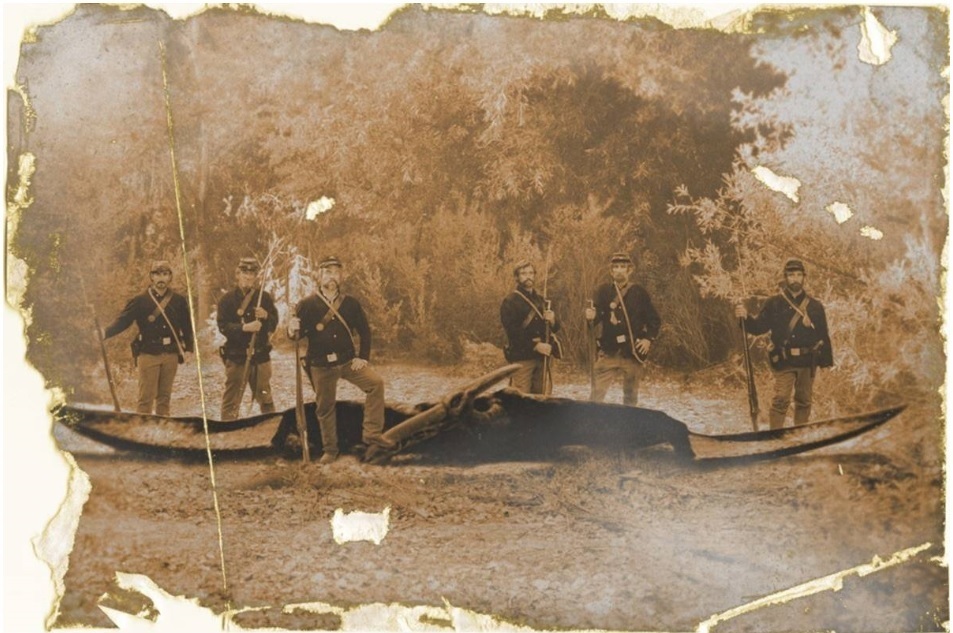
Have you ever seen a photograph of what looks like a modern pterosaur? We now examine one of the better-known photos, what appears to be a Pteranodon with Civil War soldiers:

It looks like six Civil War soldiers gathered around an apparent Pteranodon

Is this a genuine photograph from the Civil War? (click on it for enlargement)

After hours of online searching, I have found extremely differing interpretations. On Dale Drinnon’s Frontiers of Zoology blog (in a post dated 16-May-2012), he dismisses this image as “a recent construction using photoshop, not a very old photo at all . . .” but he seems to miss a critical point that shoots down all the value of Photoshop evidence.

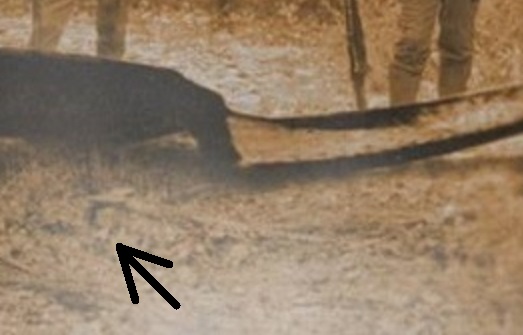
Drinnon points out places where blur is used and where image insertion seems evident. But why would those particular photo effects be used? He fails to dig deeply, apparently assuming there is no need. Why take this photo seriously if Photoshop effects are obvious? I find several reasons to take this seriously enough to continue investigating this photo. Consider these questions, remembering that Photoshop was first used by the public in 1990:

  1. Was this apparent photo constructed recently, using Photoshop?
  2. Why do some persons say that they remember this photo in a publication before 1970?
  3. Is this story an isolated report, with no other sighting reports of giant pterosaurs in the USA?

Question #1:

Let’s assume somebody decided to make a hoax photo of a convincing recently-deceased Pteranodon. Using Photoshop, how would a hoaxer make it convincing? Would he use an image of a dugout canoe for the wings of the giant pterosaur? Not likely. Would he use or construct anything looking like an image of dugout canoe? Not likely. He would probably use a sketch of a whole Pteranodon, not piece together strange parts.

Drinnon is not alone, but I find it strange that some skeptics point out small details that they interpret as evidence of Photoshop manipulation (or they have heard a rumor of such) and fail to see the whole picture. Let us be clear: This photo shows a convincing head of a Pteranodon, or similar pterosaur head, with apparent wings that look somewhat like the ends of one or two very pointed dugout canoes. I suggest nobody since the first edition of Photoshop in 1990 would spend hours creating such a hoax to fooling people into thinking that a giant Pteranodon had been killed by Civil War soldiers. Those wings are too strange.

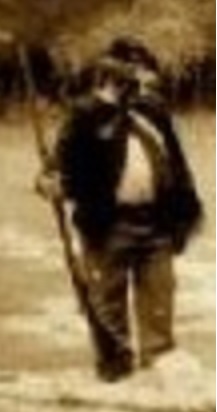
Now consider the implication of Drinnon’s proclamation that the people had halos around them (one evidence of Photoshop manipulation). What would a hoaxer do that would leave that kind of trace? What else than to insert those images of soldiers onto the background. But why go to all that trouble? He could just use an old Civil War photograph that already had soldiers in it.

I see only one good reason for a hoaxer to paste several images of individual soldiers onto a background: to hide the deception from those who might recognize the original photographs of the Civil War. But persons who know those old photographs well—those persons are rare, so the hoaxer must be extremely meticulous in his forgery. In that case, he would avoid making it at all easy for anybody to doubt what appears to be a recently-deceased pterosaur. Now we see the problem that flies in our faces: What weird wings!

Question #2:

According to one site (with which I disagree on some issues), “many people” remember reading a “‘believe it or not’ type book” that was published between 1950 and 1970. I have only a vague memory of it myself. But if one of my associates or I find it in our research, it could blow away any references to Photoshop hoaxing. We’ll see what we find.

Question #3:

Is this apparent encounter with a giant pterosaur an isolated event? Hardly. For the past nine years, I have received eyewitness reports, some of which include descriptions of a huge pterosaur-like animal flying overhead. This fits perfectly well with the concept of some Civil War soldiers being photographed next to the body of a similar creature. If genuine, the photograph would show an encounter in harmony with generations of human experience in North America.

Conclusion

I’ve not yet come to any firm conclusion about the authenticity of this photograph. I’m still keeping an open mind about its age, as well. This photograph, if recorded during the Civil War, could have been a physically contrived hoax, using one or two dugout canoes, and with a Pteranodon head added onto the photo more recently, to amplify the effect. We’ll see.

.

Three photos of possible pterosaurs

Despite the canoe-like wings, photo #3 is the most credible of these three, by far, believe it or not. My intention, however, is not to force this into an all-or-nothing, sure-thing-or-fake, judgment. Assign it whatever credibility you like . . .

.

Switch to our mobile site